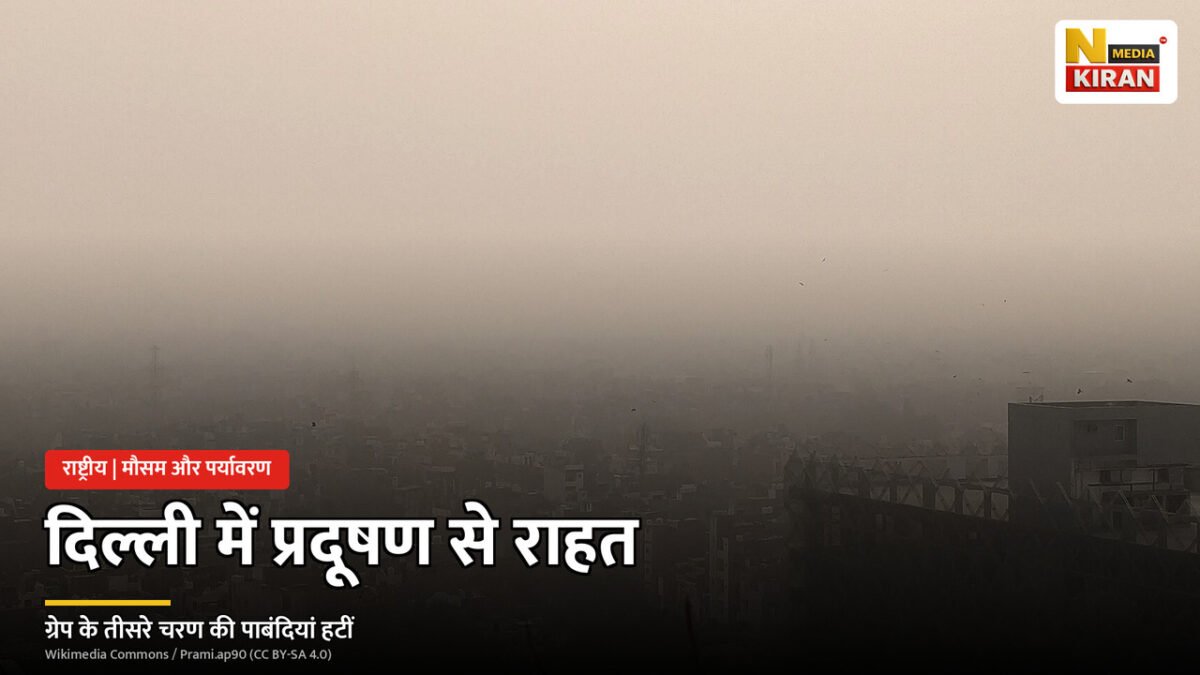
दिल्ली में प्रदूषण घटा, ग्रेप के तीसरे चरण की पाबंदियां हटीं
दिल्ली में वायु गुणवत्ता में सुधार के बाद ग्रेप के तीसरे चरण की पाबंदियां हटा दी गई हैं। शहर में न्यूनतम तापमान में भी गिरावट दर्ज की गई है।
By Sudhanshu Tiwari | News Media Kiran
प्रकाशित: · 5 मिनट में पढ़ें
शेयर करें
मुख्य बातें
Improvement in Air Quality and Regulatory Changes
Context of the Graded Response Action Plan
Temperature Decline and Seasonal Weather Shifts
13 मिनट पहले
Delhi air pollution: CAQM revokes GRAP Stage 3 restrictions
Safdarjung recorded a minimum temperature of 11.6 degrees Celsius, while Palam logged 12.3 degrees Celsius and Lodhi Road 12 degrees Celsius, according to weather data. The Commission for Air Quality Management on Tuesday revoked Stage 3 restrictions of the Graded Response Action Plan in Delhi and the National Capital Region following a continuous three day improvement in air quality.
Improvement in Air Quality and Regulatory Changes
The decision to lift the Stage 3 restrictions was taken by the Commission for Air Quality Management after the regional air quality index showed a consistent downward trend. While the third stage of the emergency plan has been removed, the commission clarified that all measures and protocols under Stage 1 and Stage 2 of the Graded Response Action Plan will remain in full force across the region. This regulatory framework is managed by the commission in coordination with the Central Pollution Control Board and various state governments to address air pollution crises.
The latest data from the Central Pollution Control Board indicated that the 24 hour average air quality index for the city was recorded at 204. This level falls into the poor category, yet it represents the best air quality recorded in Delhi throughout the month of November. The improvement is notable when compared to the air quality index of 117, which was classified as moderate, recorded on October 31. The current downward trend in the index began on Sunday when the reading was 290, followed by a reading of 275 on Tuesday.
Meteorological factors have played a significant role in this shift, specifically the increase in wind speeds which aids the dispersion of pollutants. The air quality continued to improve throughout the day on Tuesday, moving from 291 at midnight to 238 in the morning, and finally reaching 197 by the evening. This evening reading brought the city into the moderate category for the first time during the current month.
Context of the Graded Response Action Plan
The Graded Response Action Plan serves as an emergency framework designed to handle varying levels of air pollution. The classification system defines air quality index levels from zero to 50 as good, 51 to 100 as satisfactory, 101 to 200 as moderate, 201 to 300 as poor, 301 to 400 as very poor, and 401 to 500 as severe. Stage 3 of the plan is specifically invoked when the air quality index reaches or is projected to reach the severe range between 401 and 450.
The Stage 3 restrictions were initially implemented across the national capital region on November 6, at a time when the 24 hour average air quality index was 382. These measures were put in place shortly before the festival of Diwali to mitigate the impact of pollution. During the period these restrictions were active, the commission urged residents to refrain from using coal and wood for heating purposes. Furthermore, the public was advised to postpone private gatherings that could contribute to traffic congestion and outdoor exposure.
Additional guidance provided by the commission during the implementation of Stage 3 included recommendations for primary schools to adopt a hybrid mode of learning. Residents were also encouraged to work from home whenever such arrangements were feasible to reduce the overall burden of human activity on the environment. These steps were part of a broader effort to manage the air quality crisis during a period of high pollution.
Temperature Decline and Seasonal Weather Shifts
Alongside the changes in air quality, Delhi has experienced a noticeable drop in temperatures, marking the onset of the winter season. The base station at Safdarjung recorded a minimum temperature of 11.6 degrees Celsius, which represents a decline of 3.2 degrees Celsius compared to the previous day. This figure is also a significant seven degree drop from the minimum temperature of 18.6 degrees Celsius recorded on Sunday.
The cooling trend was observed across various parts of the city. Palam recorded a minimum temperature of 12.3 degrees Celsius, while the reading at Lodhi Road was 12 degrees Celsius. Other areas also reported lower temperatures, with the Ridge area recording 14.6 degrees Celsius and Aya Nagar recording 12.6 degrees Celsius. When compared to the normal long period average for this time of year, the city recorded a temperature that was 0.7 degrees Celsius lower.
The commission continues to monitor the situation closely to ensure that air quality remains stable. Agencies have been directed to focus on improving traffic flow and regulating parking at congestion hotspots to prevent future spikes in pollution levels. The scientific process of monitoring, analyzing data, and adjusting restrictions according to the prevailing air quality index remains the core strategy for managing the environmental challenges faced by the national capital.
This ongoing management strategy ensures that the city adapts to changing environmental conditions as winter progresses. By maintaining the first two stages of the action plan, the authorities aim to keep pollution levels under control while allowing for a gradual return to normal activities. The combination of meteorological changes, such as higher wind speeds, and the strict adherence to the regulatory framework has helped the region transition away from the most severe restrictions. The public remains encouraged to follow remaining guidelines to support these efforts in improving the overall air quality for all residents in the national capital territory.
Sudhanshu Tiwari handles the website and digital support for NewsMediaKiran, helping ensure the platform remains smooth, updated, and user-friendly. He specializes in website development, maintenance, and digital solutions, with a focus on creating reliable and effective online experiences.
Sudhanshu Tiwari handles the website and digital support for NewsMediaKiran, helping ensure the platform remains smooth, updated, and user-friendly. He specializes in website development, maintenance, and digital solutions, with a focus on creating reliable and effective online experiences.
Sudhanshu Tiwari handles the website and digital support for NewsMediaKiran, helping ensure the platform remains smooth, updated, and user-friendly. He specializes in website development, maintenance, and digital solutions, with a focus on creating reliable and effective online experiences.

 By